Smart Ring for Exercise Heart Rate Monitoring: Real-Time Tracking & Fat Burn Zone Calculation

Can a Smart Ring Really Handle Workout Heart Rate?
You already know smart rings excel at sleep tracking and resting heart rate. But what happens when you start sweating? When your heart rate jumps to 160 bpm during a sprint interval, can that tiny optical sensor on your finger keep up?
The short answer: Yes – with caveats.
Smart rings have evolved significantly. Modern models (Oura Gen 3, Ultrahuman Ring Air, RingConn Gen 2) use multi-wavelength PPG sensors and optimized algorithms for motion artifact reduction. However, they are not identical to chest straps. Understanding where and how they work best is the key to getting reliable exercise data.

Part 1: Where Smart Rings Shine (and Where They Struggle)
| Exercise Type | Smart Ring Accuracy | Why? |
|---|---|---|
| Walking / Hiking | ★★★★★ (Excellent) | Low motion artifact; stable finger position |
| Running (steady pace) | ★★★★☆ (Good) | Rhythmic motion; most modern rings handle well |
| Cycling (outdoor/stationary) | ★★★★☆ (Good) | Minimal hand vibration; stable grip |
| Elliptical / Stairmaster | ★★★☆☆ (Fair) | Moderate vibration; occasional dropouts |
| Weightlifting / Strength | ★★☆☆☆ (Poor) | Extreme grip pressure + rapid arm movement confuse sensors |
| Rowing / CrossFit | ★★☆☆☆ (Poor) | High vibration + irregular hand motion |
| Yoga / Pilates | ★★★★☆ (Good) | Low intensity; steady hand positions |
The engineering reality: Finger PPG sensors measure blood volume changes. During heavy grip exercises (pull-ups, deadlifts, kettlebell swings), muscle contraction compresses blood vessels in the finger, temporarily reducing signal quality. The ring may then underestimate peak heart rate by 10-20 bpm.

Part 2: Real-Time Tracking – What You Actually See on Your Ring
Smart rings do not have screens. This is both a limitation and a design advantage. Real-time tracking happens through haptic feedback (vibration) and live smartphone connectivity.
How real-time heart rate alerts work:
-
Zone vibration alerts – Set custom thresholds (e.g., vibrate when I exceed 160 bpm). The ring buzzes silently on your finger.
-
Live phone mirroring – Open your ring's companion app during a treadmill run. The phone displays your current HR, zone, and elapsed time.
-
Post-workout sync – For those who prefer distraction-free exercise, the ring records every second and syncs after you cool down.

Part 3: Fat Burn Zone Calculation – Turning Data into Weight Loss
This is where smart rings deliver genuine value. Unlike step counters or calorie estimators that rely on crude formulas, ring-based heart rate monitoring can calculate your personalized fat burn zone using two key inputs:
-
Your resting heart rate (measured during sleep)
-
Your estimated maximum heart rate (220 – age, or better: 208 – 0.7 × age)
The Five Heart Rate Zones (Karvanen formula)
| Zone | Intensity | % of Max HR | What Your Body Uses | Best For |
|---|---|---|---|---|
| 1 | Very Light | 50-60% | Fat (primary) | Warm-up, recovery |
| 2 | Light | 60-70% | Fat + Carbohydrate | Fat burning, endurance |
| 3 | Moderate | 70-80% | Carbohydrate (primary) | Cardiovascular fitness |
| 4 | Hard | 80-90% | Carbohydrate | Performance, speed |
| 5 | Maximum | 90-100% | ATP-CP | Short bursts, power |
The "Fat Burn Zone" myth clarified: You burn a higher percentage of calories from fat in Zones 1-2 (60-70% of max HR). However, you burn more total calories (including fat) in higher zones. For weight loss, the best approach is 80% Zone 2 training + 20% Zone 4/5 intervals.

Real example: 35-year-old woman
-
Max HR = 208 – (0.7 × 35) = 183 bpm
-
Fat burn zone (60-70%) = 110 – 128 bpm
-
Her smart ring vibrates when she drops below 110 bpm (walking too slow) or exceeds 128 bpm (going into cardio zone unintentionally)
During a 45-minute incline walk, she maintains 118 bpm average. Post-workout, the ring's app shows: 310 calories burned, 58% from fat. That is actionable data.

Part 4: Practical Guidelines – Getting the Most from Your Ring During Exercise
Do's ✅
-
Wear the ring on your non-dominant index finger for stability
-
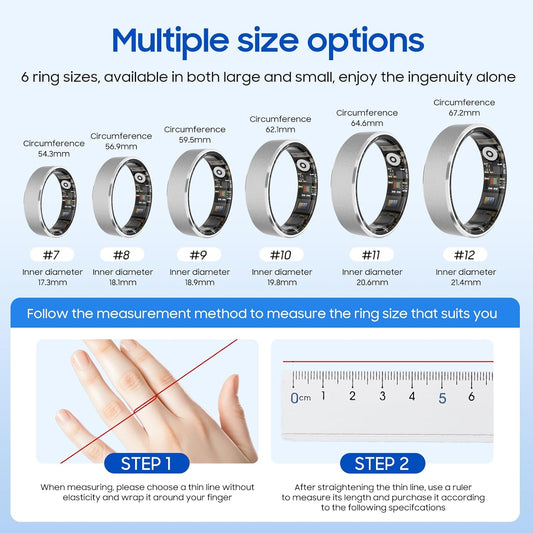
Ensure a snug fit (not loose enough to spin, not tight enough to leave deep marks)
-
For running/cycling, connect the ring to Bluetooth chest strap (some apps allow dual input – ring for rest, strap for peaks)
-
Clean the sensor after sweaty workouts (oil/salt residue degrades signal)
Don'ts ❌
-
Do NOT rely on ring alone for heavy grip sports (barbell rows, pull-ups, climbing)
-
Do NOT compare raw numbers to a chest strap during intervals (difference of ±10 bpm is normal)
-
Do NOT wear the ring on a finger that swells significantly during exercise

When to Use a Chest Strap Instead
Let us be direct: No smart ring today matches a Polar H10 or Garmin HRM-Pro for high-intensity interval training (HIIT), sprinting, or Olympic weightlifting. The chest strap uses electrical signals (ECG), which are unaffected by motion or grip pressure.
| Scenario | Best Device |
|---|---|
| All-day wellness + sleep + steady cardio | Smart ring ✅ |
| HIIT, sprints, heavy strength training | Chest strap ✅ |
| Both? | Wear ring 24/7 + chest strap for hard workouts, then import data to your ring's ecosystem (Apple Health / Google Fit) |

Final Takeaway: Know Your Tool's Strengths
A smart ring is an extraordinary 24/7 health tracker. For exercise heart rate, it is excellent for steady-state cardio (walking, jogging, cycling, elliptical) and fat zone calculation. It is not your best choice for explosive, high-motion, or grip-intensive activities.
Use it strategically. Let the ring guide your Zone 2 days and recovery. Save the chest strap for PR attempts. And watch your fitness ceiling rise – one heartbeat at a time.