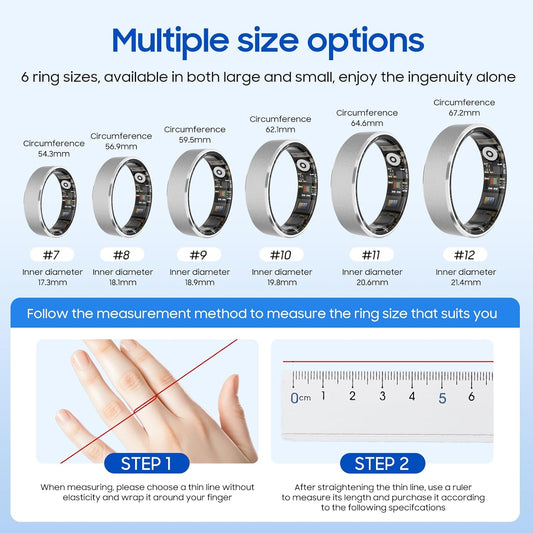
Home Screening for Obstructive Sleep Apnea (OSA): Smart Ring AHI Monitoring Capabilities

The Silent Epidemic: Why OSA Goes Undiagnosed
Obstructive Sleep Apnea (OA) is one of the most common chronic diseases in the world—yet up to 80% of the estimated 30 million US adults with OSA remain undiagnosed. Untreated sleep apnea is associated with a nearly fourfold increase in all-cause mortality and significantly increased risks of hypertension, heart disease, stroke, and cognitive decline.
The problem? Traditional diagnosis requires an overnight stay in a sleep lab attached to 20+ wires—a process that is expensive, inconvenient, and often has months-long waiting lists.
But what if a tiny ring on your finger could screen for sleep apnea at home, with clinically validated accuracy?
This guide explains how smart rings detect OSA using photoplethysmography (PPG) technology, what the research says about their accuracy, and how you can use one to assess your own risk.

Part 1: What Is Sleep Apnea and Why Does It Matter?
The Condition
Obstructive Sleep Apnea occurs when your throat muscles relax so much during sleep that your airway collapses. You stop breathing—sometimes for 10 seconds or more. Your brain senses the danger and jolts you partially awake to gasp for air. This cycle can repeat hundreds of times per night.
The Key Metric: AHI (Apnea-Hypopnea Index)
OSA severity is measured by the Apnea-Hypopnea Index (AHI) —the number of breathing events per hour of sleep.
| AHI Score | OSA Severity | Health Risk |
|---|---|---|
| < 5 | Normal / No OSA | Minimal |
| 5 – 15 | Mild OSA | Low to Moderate |
| 15 – 30 | Moderate OSA | Moderate to High |
| > 30 | Severe OSA | High |

Common Symptoms of OSA
| Symptom | Why It Happens |
|---|---|
| Loud, persistent snoring | Airway vibration during partial collapse |
| Gasping or choking during sleep | Airway completely closes; brain wakes you to breathe |
| Morning headache | Low oxygen and high CO₂ overnight |
| Excessive daytime sleepiness | Fragmented sleep prevents restorative rest |
| Dry mouth upon waking | Mouth breathing due to nasal airway obstruction |
| Difficulty concentrating | Sleep fragmentation affects cognitive function |

Part 2: How Smart Rings Detect Sleep Apnea – The Monitoring Principle
The Core Technology: PPG and SpO₂
Smart rings cannot measure airflow or brain waves. Instead, they use photoplethysmography (PPG) —the same technology used in hospital pulse oximeters—to measure blood oxygen saturation (SpO₂) continuously throughout the night.
Here is the principle:
| Component | Function |
|---|---|
| Red LED (660 nm) | Measures deoxygenated hemoglobin absorption |
| Infrared LED (940 nm) | Measures oxygenated hemoglobin absorption |
| Photosensor | Detects returning light |
| Algorithm | Calculates SpO₂ from absorption ratio |
The Key Metric: ODI (Oxygen Desaturation Index)
When a person with OSA stops breathing, their blood oxygen level drops. The ring detects these drops—called desaturation events—and calculates the Oxygen Desaturation Index (ODI) : the number of times per hour that SpO₂ drops by 3% or 4% from baseline.
The relationship: In patients with OSA, ODI correlates very strongly with AHI (the clinical gold standard). A high ODI strongly suggests a high AHI.
| OSA Severity | Typical ODI (3% desaturation) |
|---|---|
| Normal | < 5 events/hour |
| Mild OSA | 5 – 15 events/hour |
| Moderate OSA | 15 – 30 events/hour |
| Severe OSA | > 30 events/hour |

The Algorithm: From Raw Data to AHI Estimation
The ring's algorithm works in several steps:
Step 1: PPG sensor records raw light absorption data (every 1-5 seconds)
        ↓
Step 2: Calculate beat-to-beat SpO₂
        ↓
Step 3: Detect desaturation events (SpO₂ drop ≥3% or ≥4% from baseline)
        ↓
Step 4: Calculate ODI (events per hour)
        ↓
Step 5: Apply machine learning model trained on PSG data
        ↓
Step 6: Estimated AHI and OSA severity classification

Part 3: Clinical Validation – What the Research Says
Multiple peer-reviewed studies have validated smart rings for OSA screening. Here is the evidence.
Study 1: Belun Ring Meta-Analysis (2025)
A systematic review and meta-analysis published in Sleep and Breathing analyzed four prospective studies involving 339 patients comparing the Belun Ring Platform against PSG.
| OSA Severity | Sensitivity | Specificity | AUC |
|---|---|---|---|
| Moderate-to-Severe (AHI ≥ 15) | 92% | 81% | Excellent |
| Severe (AHI ≥ 30) | 66% | 95% | Excellent |
| Mild (AHI ≥ 5) | 97% | 18% (poor) | Limited |
Key conclusions: "The Belun Ring platform demonstrates high sensitivity for detecting OSA and excellent specificity for severe OSA, supporting its utility as an effective tool for diagnosing OSA in adults with suspected moderate to severe disease."

Study 2: Circul Ring Study (2025)
A study published in Respiratory Medicine evaluated the Circul ring in 164 patients suspected of sleep-disordered breathing.
| OSA Severity | Optimal ODI3 Cutoff | Sensitivity | Specificity | AUC |
|---|---|---|---|---|
| AHI ≥ 5 | 4.3 | 87.8% | 93.8% | 0.946 |
| AHI ≥ 15 | 13.1 | 76.3% | 100% | 0.956 |
| AHI ≥ 30 | 16.2 | 85.7% | 92.0% | 0.960 |
Key finding: "cODI3 % greater than 13 suggests that significant OSA might be present." The ring achieved 100% specificity for AHI ≥ 15, meaning every patient flagged as having moderate-severe OSA truly had it.

Study 3: Wellue O2 Ring Study (2024)
A study published in Nature evaluated the Wellue O2 ring in 190 participants (mean AHI 50.4, 84.7% with moderate-severe OSA).
| Metric | Value |
|---|---|
| Optimal ODI cutoff | 1.25 events/hour (20s duration) |
| Sensitivity | 87.30% |
| Specificity | 78.70% |
| AUC | 0.91 |
Conclusion: "The Wellue O2 ring demonstrated high accuracy in detecting moderate to severe OSA and could be a viable alternative for screening in clinical settings."
Study 4: Happy Ring – FDA Clearance (2025)
The Happy Ring received FDA Class II clearance for at-home diagnosis of obstructive sleep apnea and insomnia. According to the manufacturer:
-
97% concordance with gold-standard in-lab PSG
-
Patients order a sleep test online, wear the ring overnight, then review results via telehealth with a board-certified sleep physician
-
Treatment plans (CPAP, oral appliance, GLP-1s) are covered by most major insurers

Systematic Review Summary (2026)
A comprehensive systematic review and meta-analysis of 11 finger-worn devices across 28 studies concluded:
| Finding | Result |
|---|---|
| Sleep/wake classification | Pooled accuracy 87% |
| Severe OSA screening (AHI ≥ 30) | Higher accuracy than for mild/moderate |
| Mild OSA detection (AHI ≥ 5) | Limited accuracy |
| Clinical recommendation | "Finger-worn devices may be used as a triage tool for severe OSA, but should not replace PSG for diagnosis of mild OSA." |

Part 4: How Accurate Are Smart Rings for OSA Screening?
Accuracy Summary Table
| Device | OSA Severity | Sensitivity | Specificity | FDA Status |
|---|---|---|---|---|
| Belun Ring | AHI ≥ 15 | 92% | 81% | FDA Cleared |
| Circul Ring | AHI ≥ 15 | 76% | 100% | Research |
| Wellue O2 Ring | Moderate-Severe | 87% | 79% | Class II Listed |
| Happy Ring | OSA Diagnosis | 97% concordance | FDA Cleared |
What These Numbers Mean for You
| If your ring shows... | Likely Reality | Recommended Action |
|---|---|---|
| ODI < 5 | Normal (low OSA risk) | Continue routine monitoring |
| ODI 5-15 | Possible mild OSA | Monitor symptoms; consider lifestyle changes |
| ODI 15-30 | Likely moderate OSA | Consult doctor; consider sleep study |
| ODI > 30 | Very likely severe OSA | Seek medical evaluation promptly |

Part 5: Limitations – What Smart Rings Cannot Do
Even the most accurate smart ring has important limitations.
The Korean Smart Ring Study (2026)
A prospective study presented at the Korean Otolaryngology Society meeting analyzed 85 participants wearing a Samsung smart ring during PSG.
| Finding | Result |
|---|---|
| Correlation between eAHI and pAHI | r = 0.874 (strong) |
| ICC agreement | 0.727 (moderate-to-good) |
| Mean error | eAHI underestimated pAHI by 10.8 events/hour |
| AUC for AHI ≥15 | 0.923 |
| AUC for AHI ≥30 | 0.967 |
Conclusion: The smart ring showed "excellent diagnostic performance" for moderate-to-severe OSA with an AUC > 0.92, though it tended to underestimate severity.

Part 6: How to Use Your Smart Ring for OSA Screening
Step-by-Step Guide
| Step | Action | Why |
|---|---|---|
| 1 | Wear ring for 7-14 consecutive nights | Single night has high variability |
| 2 | Ensure snug fit on non-dominant finger | Loose fit causes false desaturations |
| 3 | Review overnight SpO₂ graph | Look for sawtooth pattern of drops |
| 4 | Check your ODI (Oxygen Desaturation Index) | Primary screening metric |
| 5 | Note lowest SpO₂ and time below 90% | Additional risk indicators |
| 6 | Correlate with symptoms (snoring, fatigue) | Symptom + ODI > 15 = high suspicion |
| 7 | Share data with your doctor | Bring 7-14 nights of ODI trends |
Red Flags – When to See a Doctor
| Warning Sign | Action |
|---|---|
| ODI > 15 on multiple nights | Schedule sleep medicine consultation |
| Lowest SpO₂ < 85% | Concerning for moderate-severe OSA |
| Time below 90% > 5 minutes | Significant hypoxemia |
| Sawtooth pattern + daytime sleepiness | Classic OSA presentation |
| Loud snoring + gasping reported by partner | High clinical suspicion |

Quick Reference Card: Smart Ring OSA Screening
| Question | Answer |
|---|---|
| Can smart rings detect sleep apnea? | Yes – for moderate-to-severe OSA screening |
| What metric do they use? | ODI (Oxygen Desaturation Index) |
| How accurate is it? | 87-92% sensitivity for AHI ≥15 |
| Is it FDA approved? | Some rings (Belun, Happy) have FDA clearance |
| Can it replace a sleep study? | No – screening tool, not diagnostic |
| What ODI suggests OSA? | > 15 events/hour (high suspicion) |
| Best ring for OSA screening? | Belun, Circul, Wellue, Happy (clinically validated) |

Final Takeaway: A Powerful Screening Tool, Not a Diagnosis
The evidence is clear: smart rings can effectively screen for moderate-to-severe obstructive sleep apnea with clinically meaningful accuracy.
| Use Your Ring For | Do Not Use Your Ring For |
|---|---|
| Screening for moderate-severe OSA risk | Definitively diagnosing OSA |
| Tracking ODI trends over multiple nights | Ruling out mild OSA |
| Identifying need for sleep study referral | Measuring sleep architecture |
| Monitoring treatment response (CPAP, oral appliance) | Distinguishing central from obstructive events |
| Providing data to share with your doctor | Making treatment decisions alone |
If your smart ring shows an ODI consistently above 15 events per hour—especially if you have symptoms like loud snoring, gasping, or daytime sleepiness—see a doctor. A sleep study is the only way to definitively diagnose OSA.
But for the millions of people who are suffering in silence, undiagnosed and untreated, a smart ring could be the first step toward better sleep, better health, and a longer life.